What really separates the two banks?
The nature of the soil, and what it does to the temperature around the roots. Everything follows from that.
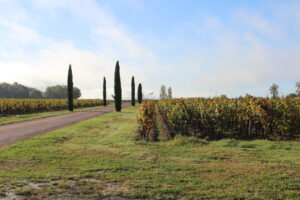
A note on geography for readers new to Bordeaux. The Gironde estuary splits the region in two. The Left Bank means the Médoc and Graves; the Right Bank means Saint-Émilion, Pomerol and Lalande-de-Pomerol, around the town of Libourne. Château La Fleur de Boüard sits at Néac, on that right bank.
The Left Bank rests on deep mounds of gravel, rounded stones laid down by the river. Gravel drains fast and stores the day’s heat, releasing it at night. It is a warm soil.
The Right Bank rests on clay, sand and gravel mixed together. Clay holds water, and a soil that holds water stays cold. It warms slowly in spring and keeps its coolness through summer.
A warm soil and a cold soil do not ripen the same grapes.
Why does Merlot cope with clay?
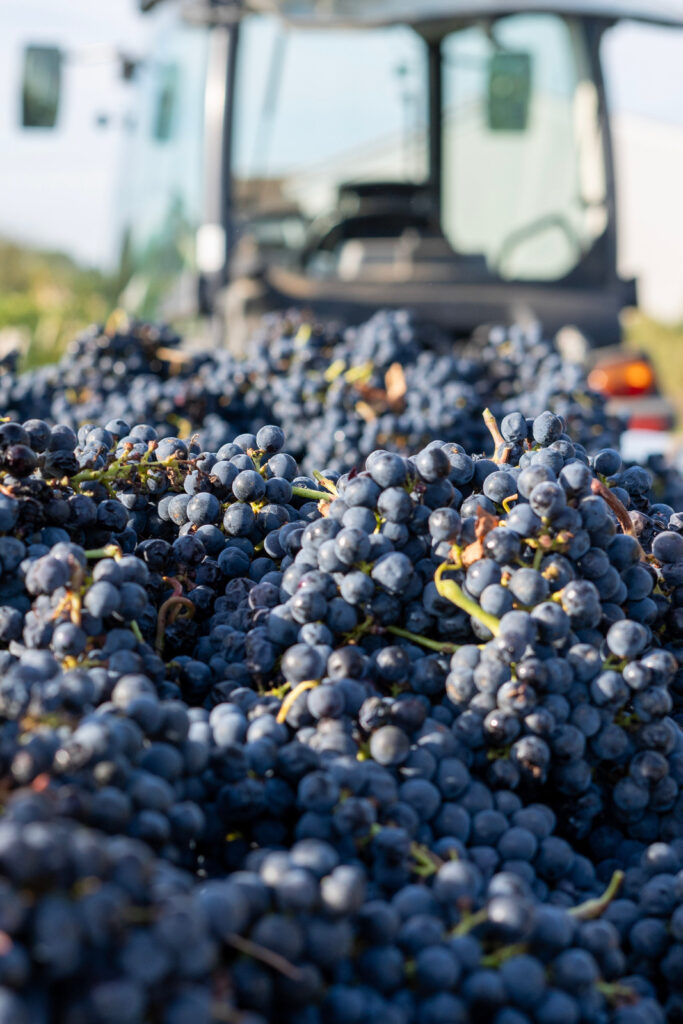
Because it ripens early, and cold soil delays everything. Merlot buds early and reaches maturity roughly two weeks ahead of Cabernet Sauvignon. On a soil that slows ripening, those two weeks make the difference: they allow the fruit to ripen before the autumn rains arrive.
There is a second advantage, less often mentioned. Clay holds water, and so feeds the vine through dry summers. Merlot, thirsty and sensitive to water stress, finds a regularity here it would not have on free-draining gravel.
The result in the glass is well known: flesh, volume, supple tannins and deep colour. That is what our terroirs at Néac produce.
Why does Cabernet Sauvignon fail here?
Because it lacks time and warmth. Cabernet Sauvignon is a late variety with a thick skin, needing long warm ends of season for its tannins to ripen.
Planted on cold clay, it arrives too late. You then pick green tannins — that rasping astringency which never fully rounds out — and aromas of green pepper rather than blackcurrant. On the warm gravels of the Médoc it gives its best.
So it is not that Cabernet is better or worse: it is unsuited to this particular soil. The Right Bank keeps a few per cent of it, but on its most gravelly parcels, precisely where the ground warms up.
What is Cabernet Franc for, then?
It is the backbone. The historic partner of Merlot on the Right Bank, and the variety hurried tasters overlook.
Cabernet Franc ripens earlier than Cabernet Sauvignon, which makes it compatible with cold soils. It brings what Merlot does not: freshness, tension, an aromatic line of red fruit and spice, and above all an acidity that stops the wine collapsing over the years.
A pure Merlot can be delicious and lack spine. Add a few per cent of Cabernet Franc and the same wine stands upright for fifteen years. It is an architect’s role rather than a soloist’s.
Is Merlot an easy grape?
No, and this is the most common misreading. Its reputation for softness comes from what it gives in the glass, not from what it asks of the grower.
Merlot buds early, so spring frost is a threat. It is prone to poor fruit set at flowering. Its thin skin leaves it vulnerable to rot in a wet autumn. And it loses acidity very quickly at the end of ripening: a few days too many and the wine turns heavy and jammy, with no nerve.
The picking window for Merlot is therefore narrow — often a matter of days. Which is why the fruit is vinified plot by plot: every soil ripens at its own pace, and a clay parcel is not picked on the same day as a gravel one.
Does a warming climate change this?
It shifts it. Hotter, drier summers penalise Merlot first, since it fears water stress and loses acidity when ripening runs late. On paper that would argue for more Cabernet.
In practice the answer has been agronomic rather than varietal: picking earlier, working the soils so they hold water better, protecting microbial life, adapting how the vine is trained. Clay, long seen as a cold constraint, becomes a precious water reserve.
Which means the very thing that made Merlot strong here may keep doing so — for exactly the opposite reason to fifty years ago.
How does it taste?
Three things, recognisable even without experience — and worth trying side by side.
Texture first: a Right Bank Merlot coats the palate where a Médoc Cabernet structures it more severely. Fruit next: plum and black cherry on one side, blackcurrant and graphite on the other. Tempo last: the Right Bank opens earlier, often at five to eight years, where the Left Bank asks for a decade.
Pour a Right Bank wine and a Médoc of similar age together. The first will feel rounder at the front of the palate, the second firmer at the back. That difference in where the wine grips is the clearest signature of the two banks, clearer than any aroma.
Then look at the finish. Merlot tends to fade gently; Cabernet Sauvignon holds a tannic edge that keeps going. Neither is better — one suits a Tuesday dinner, the other a bottle you have waited a decade for.
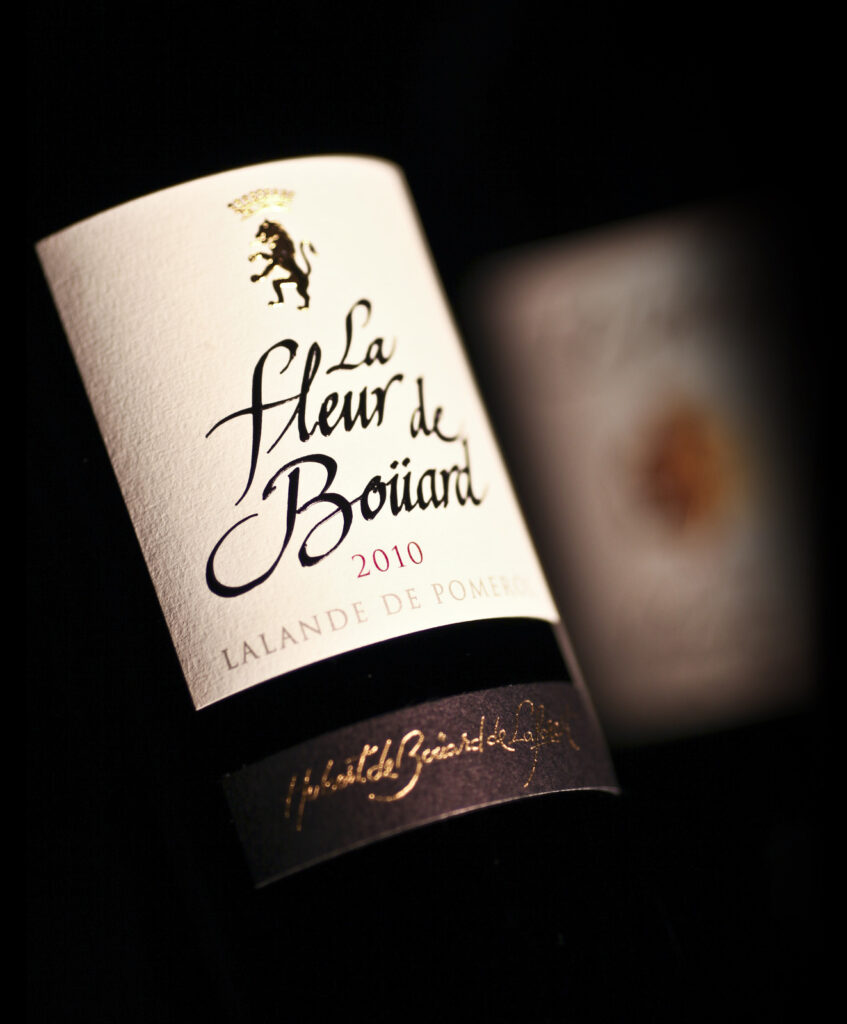
Our estate wines are all Merlot-led, and tasting them against one another shows how much a few per cent of Cabernet Franc changes the shape of a wine.
In short
The clay of the Right Bank is a cold soil. Merlot ripens on it because it is early; Cabernet Sauvignon does not because it is late. Cabernet Franc, in between, supplies freshness and staying power. What looks like a regional tradition is really the outcome of a long selection by the ground itself.
And Merlot is not the easy grape it is taken for: it gives an approachable wine at the cost of demanding viticulture.
Your questions answered
What proportion of Merlot is planted on the Right Bank?
In Pomerol, plantings run at around 80% Merlot, 15% Cabernet Franc and 5% Cabernet Sauvignon. Proportions vary from estate to estate.
Can a great wine be made from 100% Merlot?
Yes, and some of the most sought-after bottles of the Libournais are. Cabernet Franc nonetheless remains valuable for freshness and for holding up over time.
Why does Cabernet Sauvignon dominate the Left Bank?
Because its gravel mounds are warm and free-draining, which lets this late variety reach full ripeness.
Does Merlot age less well than Cabernet?
It reaches maturity earlier, which is not the same thing. The most structured Right Bank cuvées hold perfectly well for fifteen years and more.
Are other varieties grown in the region?
Malbec, known locally as Côt, is permitted in several Libournais appellations. Some estates also grow more unexpected varieties on small parcels.