What is a hybrid offsite, exactly?
An offsite where some participants are on site and others join remotely, with an equal right to speak. That is the distinction: if remote participants listen without intervening, it is not hybrid, it is a broadcast.
Three situations make it necessary. Teams spread across several sites or countries. Colleagues who cannot travel for two days. And, increasingly, a wish to limit journeys without giving up collective time.
The format carries a hidden cost: it takes more preparation than a conventional offsite, because you are designing two simultaneous experiences instead of one.
What breaks first?
The sound, almost always — not the picture. This is the most useful observation in the whole article.
A remote participant forgives a mediocre image. They drop out within minutes if they cannot hear the question asked at the back of the room, or if they receive the reverberation of an over-large space. And once they drop out, they do not come back.
The two causes are always the same. A single microphone next to the facilitator, which picks up the person on the mic beautifully and the other fifteen badly. And a reverberant room, where every utterance returns with a delay that blurs the rest.
The practical consequence is simple: if there is one line left in the technical budget, it goes into capturing the room’s sound, not into camera quality.
What should you check in the room?
Four things, in this order. They are checked on a site visit, not from a spec sheet.
- The acoustics. Clap your hands in the middle of the empty room. If the echo lingers, you will need distributed microphones and furniture that absorbs.
- The internet bandwidth, and above all its stability once forty phones join the same network.
- The power sockets, and where they are. An extension lead crossing a walkway is an incident waiting to happen.
- The natural light. Lovely to sit in, disastrous to film if speakers stand in front of a window: the camera sees a black silhouette.
At Château La Fleur de Boüard, at Néac in the Lalande-de-Pomerol appellation a few minutes from Saint-Émilion, the estate lists high-speed wifi, flip charts, projection screens and a screen with HDMI cable, along with natural light in the rooms. The exact technical set-up is confirmed on the quote.
Do all rooms film equally well?
No, and the gap is wider than between two hotel rooms. This is exactly what makes the choice of space strategic at a wine estate.
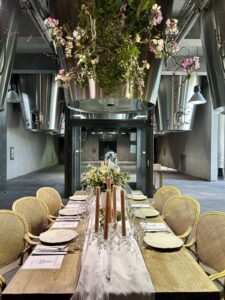
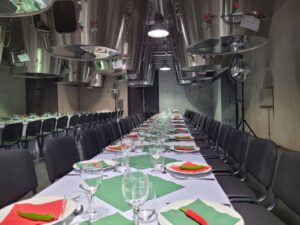
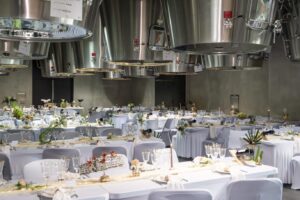
A vat room looks remarkable on screen: the vats behind the speaker immediately identify the place, and remote participants can see that something is happening somewhere. That is a genuine staging advantage. But stainless steel throws sound back, and the volume is large: it is the room that demands the most care with microphones.
A barrel cellar does the opposite. Less spectacular on camera, far easier to mic, because wood absorbs. For a plenary of forty with twenty joining remotely, it is often the better compromise.
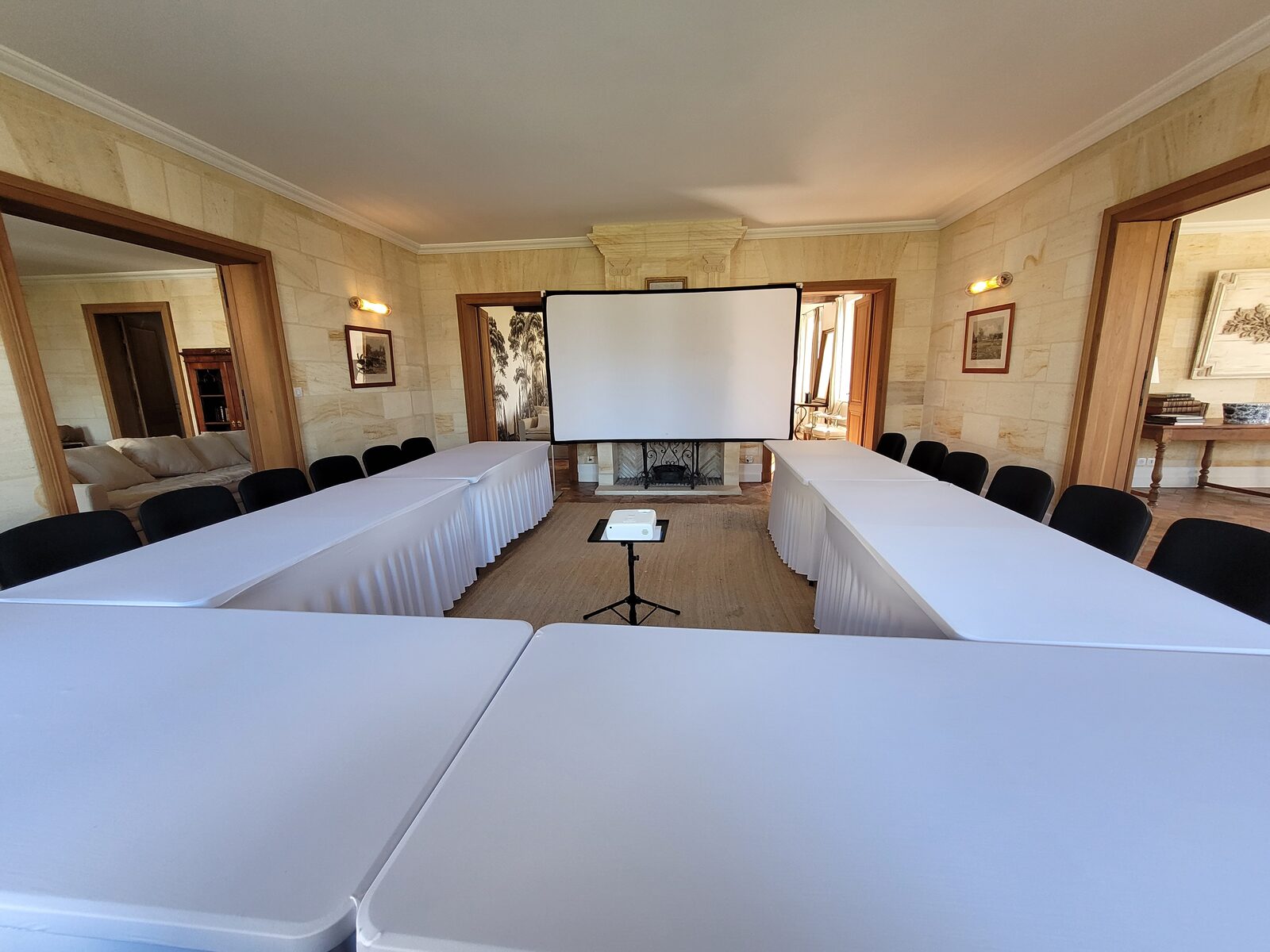
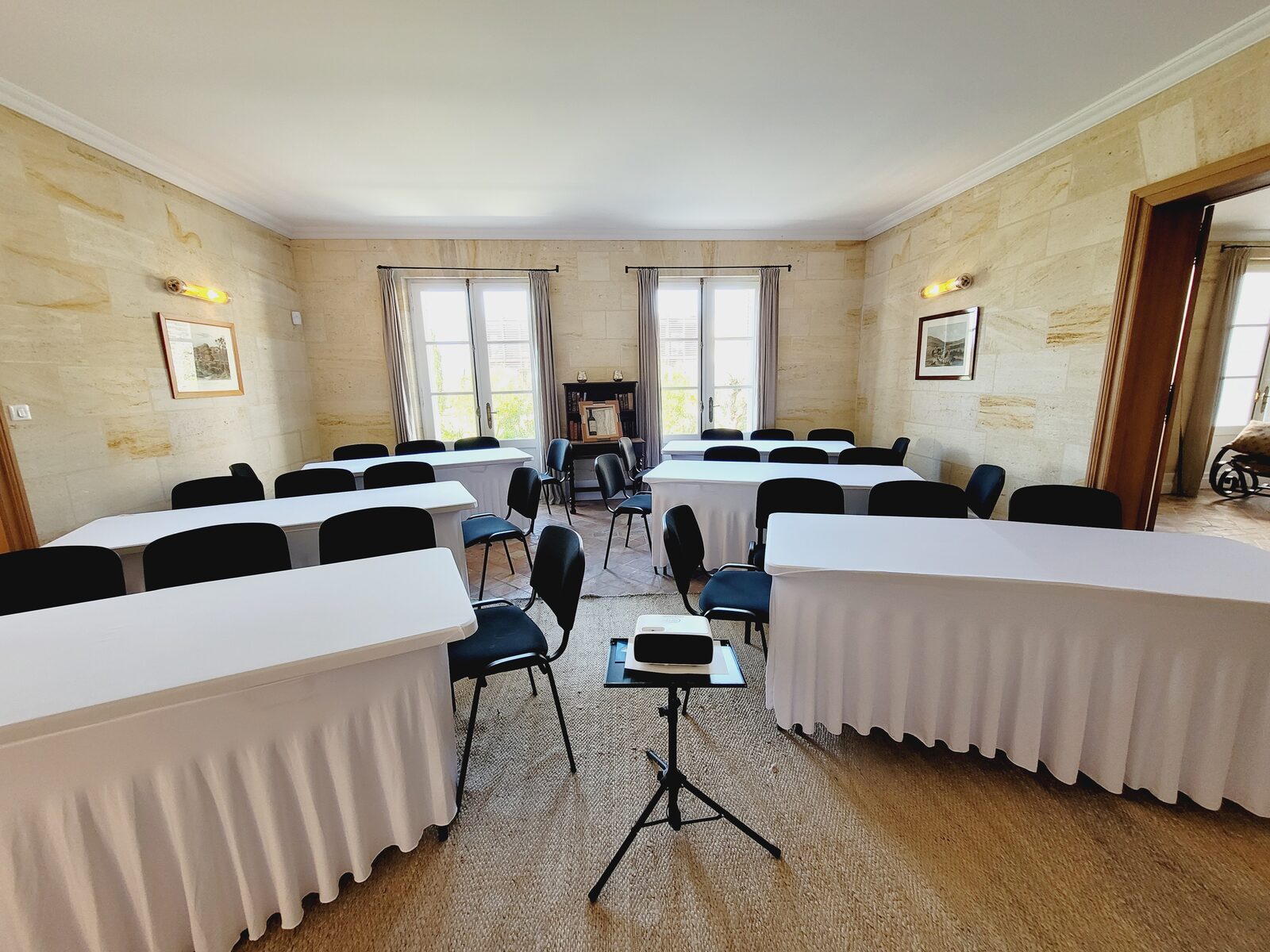
A house meeting room, smaller and more hushed, suits small committees where everyone speaks. Our piece on choosing the right space for the event sets out those trade-offs.
How should you structure the day?
Reserve remote participation for the sequences that survive a screen, and keep the rest for the room. Mixing the two continuously exhausts everyone.
What works remotely: the top-down plenary, the figures presentation, a chaired question-and-answer session, the progress review. Anything with an agenda and a facilitator.
What works badly: breakout workshops, brainstorming, and any sequence that depends on spontaneity. Remotely, nobody interrupts, so nobody builds on anyone else.
A structure that works for a single day: a hybrid morning — plenary, figures, questions, everyone connected — then an in-person afternoon for workshops and informal time, with a short wrap-up at the end of the day for those who stayed remote. Remote participants then know when they are expected, and when they can get on with their own work.
What does the estate provide, and what do you bring?
The venue, the network, the screens and the comfort; the rest belongs to your AV supplier. The distinction is worth settling before you sign.
A wine estate provides private spaces, furniture, wifi, screens and flip charts, and catering. It is not a studio: the control desk, ambient microphones, a managed camera and someone watching the stream for three hours are not part of the standard package.
Two consequences. First, plan for a technical supplier if the stakes are real — a product launch, an annual convention. Second, run a rehearsal the day before, in the actual room, with one person connecting from outside. That is the only test worth anything.
The estate imposes no exclusive caterer, which also keeps that part of the budget in your hands. Package details are on the seminars and events page.
Can the social part be shared remotely?
Yes, provided you think about it a week ahead rather than on the morning. This is the structural weakness of hybrid: the people on site live a moment, the people connected watch others live it.
The simplest answer at a wine estate is to send the same wines in advance to remote participants and run the tasting together — the host comments, everyone has a glass in hand. It works because it is sensory: you are tasting the same thing at the same time, and no screen prevents that.
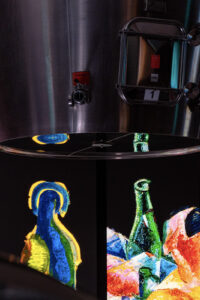
Filming a cellar tour live, by contrast, rarely goes well: the walking, the noise and the changing light make the stream tiring. Better to offer remote participants a sequence designed for them — short, seated and narrated. The immersive Chai des Lumières experience is in fact better recounted afterwards than streamed live.
So is it worth moving people at all?
Yes, but not to sit them in front of a screen. Every hybrid offsite raises the question, and it deserves an honest answer.
If the day consists of top-down presentations, travelling adds nothing: do it all remotely and save the journeys. Being in the room is only justified by what it allows and a screen forbids — corridor conversations, disagreements settled standing up, people who actually meet.
That is where the venue comes in. A wine estate a few minutes from Saint-Émilion offers exactly what an airport conference suite does not: a short change of scene, a setting that starts conversations, and outdoor space where a group can disperse and re-form.
In short
A hybrid offsite is won on sound, not on picture. It calls for structuring the day rather than blending everything, a technical supplier when the stakes are real, a rehearsal the day before in the actual room, and deliberate attention to the social moment, which does not share itself.
As for the venue: the vat room gives you the image, the barrel cellar gives you the sound. Decide which of the two matters more for your day.
Frequently asked questions
What is a hybrid offsite?
An offsite where some participants are on site and others join remotely, with an equal right to speak. If remote participants only listen, it is a broadcast rather than a hybrid meeting.
What fails most often?
The sound. A remote participant tolerates a mediocre image but drops out if they cannot hear the questions asked in the room.
Which space is best for filming a plenary?
The vat room gives the best backdrop but needs the most care with microphones; the barrel cellar is easier to mic because wood absorbs sound.
Is video-conferencing equipment provided?
The estate lists high-speed wifi, projection screens, a screen with HDMI cable and flip charts. The control desk, ambient microphones and the stream itself belong to an AV supplier. Details are confirmed on the quote.
Can remote participants join a tasting?
Yes, by sending them the same wines in advance and hosting the tasting simultaneously. It is the format that works best at a distance.
How many people can the estate host?
The Emile Peynaud vat room, around 230 m², seats in the order of 130 people. Capacities are confirmed according to the layout chosen.