Can you really stay here without a car?
Yes, for a stay centred on the vineyard. It does need a little organising, which arriving by car does not.
The logic runs like this: the train solves the arrival, the estate shuttle solves the last mile, and an electric bike solves getting about locally. What stays out of reach — a day trip to the Médoc or the coast — falls outside a wine-focused stay anyway.
There is even an advantage drivers do not get: nobody has to be the one not drinking.
How do you get to Libourne?
By train, and this is the area’s real strength. Libourne station is served by the high-speed Paris–Bordeaux services and by regional trains from Bordeaux. That sets the Libournais apart from most of the Bordeaux vineyard, where the nearest station is far away.
In practice, a vineyard weekend from Paris — or from London via Paris — needs no car hire and no awkward connection: one train, then a shuttle.
For arrivals by air, Bordeaux-Mérignac is the usual entry point, with a rail or road connection onwards.
How do you cover the last few miles?
The estate runs a transfer service from the station and from the airport. It is the simplest option and is booked at the same time as the stay or the tour.
It is also the one to plan ahead: a shuttle is not a taxi and needs arranging in advance. The useful habit is to give your train time when you book, not the night before you travel.
The estate describes itself as about ten minutes from the medieval village of Saint-Émilion, which gives a sense of the distances involved: everything is close, but nothing is walkable.
Are electric bikes a genuine option here?
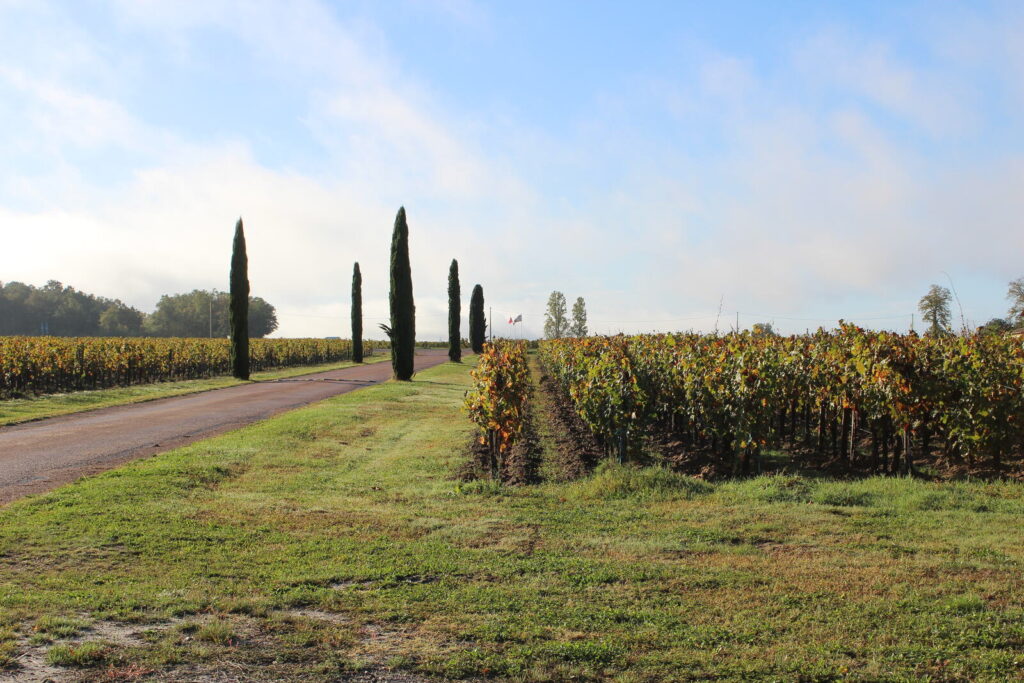
Yes, and it is the pleasant surprise of the area. The estate offers electric bikes, and the terrain suits them: distances between Néac, Pomerol, Libourne and Saint-Émilion are short, and the roads are quiet country lanes.
Electric assistance removes the only real obstacle, which is the slope. Néac is the hillier part of the Lalande-de-Pomerol appellation, and what would be hard work on a standard bicycle is effortless with a motor.
What can you do in a day without a car?
A good deal, provided you think in loops rather than out-and-back trips.
- A tour and tasting at the estate, on foot from your accommodation if you are staying on site.
- A bike loop through the vines of Néac, the Pomerol plateau and the edges of Saint-Émilion.
- A day in Saint-Émilion, shuttle out and bike back, or the reverse.
- Dinner at the estate, with no drive afterwards.
None of these requires a steering wheel, and all of them are booked from the same place.
Can you take wine home without a car?
Yes, and it is the question nobody asks before setting off. Nothing is more frustrating than discovering a wine and giving up on taking it home for want of a boot.
Three solutions coexist. Shipping from the estate, which settles everything and spares you carrying weight on a train — the simplest route for a case or more. Buying within your means, limiting yourself to what you can carry: two or three well-chosen bottles travel easily in a rigid bag. And ordering later, noting the wines you tasted and reordering once home, using our estate wines page as a reminder.
One practical tip: decide before the tasting, not after. Everyone overestimates what they are willing to carry just after tasting something they liked.
What should you bring?
Not much, but it matters when you have no car to serve as a wardrobe.
- Shoes that can meet soil: rows of vines are not park paths.
- A jacket, even in summer: cellars are kept cool all year.
- Your train times, given to the estate when booking the shuttle.
- A rigid bag if you plan to take bottles home.
Everything else is arranged on site, provided you have given notice. That is the general rule of a car-free stay: what is decided the day before is decided badly.
The estate’s tours and tastings and its places to stay are all booked from the same place, which keeps the planning to a single conversation.
What is the honest drawback?
Spontaneity. Without a car you do not decide at noon to drive twenty-five miles for lunch. Shuttles are booked, trains have timetables, and a bike ride is planned around daylight.
In practice this changes the quality of the stay less than you would expect, and its rhythm a great deal: you stay longer in one place, walk more, and get back earlier. It is not a compromise, it is a different trip.
A car is still preferable for a stay that ranges well beyond the Libournais — into Bordeaux itself, to the coast, or up the Dordogne valley.
Who does this suit best?
Three kinds of visitor, fairly clearly.
Couples, for whom the designated-driver problem spoils a tasting day. Visitors from abroad, who would rather not follow a flight and a train with a car hire desk. And people who come to taste rather than to cover ground: they gain outright, since everything that interests them sits within a few miles.
It suits less well families with young children, for whom cycling is not an option, and trips that want to take in Bordeaux, the Médoc and the coast in one week.
In short
Train to Libourne, estate shuttle for the last mile, electric bike on site. Three solutions that dovetail, and that make Néac reachable without a car — still rare in the Bordeaux vineyard.
Book the shuttle at the same time as the tour or the stay, giving your train times. That is the only real constraint.
Your questions answered
Which is the nearest station?
Libourne, served by high-speed Paris–Bordeaux services and by regional trains from Bordeaux.
Does the estate offer transfers from the station?
Yes. A transfer service from the station or the airport is among the optional services, and is booked in advance.
Can you hire bikes on site?
The estate offers electric bikes as an option, booked with your stay.
Can you cycle to Saint-Émilion from Néac?
The distances suit it and electric assistance absorbs the slopes. Plan the route in advance and ask the estate for advice when booking.
Do you need a car to visit other châteaux?
Not within the immediate Libournais, where estates sit close together. A car becomes useful for leaving the area.
How do you get bottles home?
By shipping from the estate, or by limiting yourself to what you can carry. Decide before the tasting rather than after.