Where do you start?
With three decisions, and nothing else. The number of guests, the season, and whether guests sleep on site.
The setting here: Château La Fleur de Boüard at Néac, in the Lalande-de-Pomerol appellation on Bordeaux’s Right Bank, minutes from Saint-Émilion.
Those three answers open or close most of the possibilities. A wedding for a hundred and thirty does not fit the same venues as one for forty. A Saturday in June does not book like a Friday in October. And a wedding where close family stays over needs beds — a far scarcer resource than a room.
Everything else — caterer, decoration, dress, music — is decided afterwards, and decided better.
Twelve months out: the venue and the date
The only genuine urgency. A venue can host one wedding at a time, and Saturdays in the warmer months are the most contested resource in the calendar.
Twelve months is a floor rather than a norm: Château La Fleur de Boüard finds its weddings are frequently booked one to two years ahead. If your date is a summer Saturday, assume the countdown starts earlier than what is written here.
Arrive with two or three acceptable dates rather than one. A couple with a single date is at the mercy of the venue’s calendar; a couple with three almost always secures one of them, often on better terms.
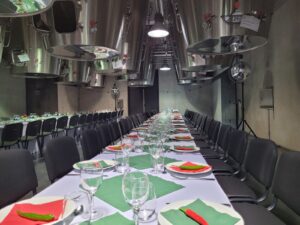
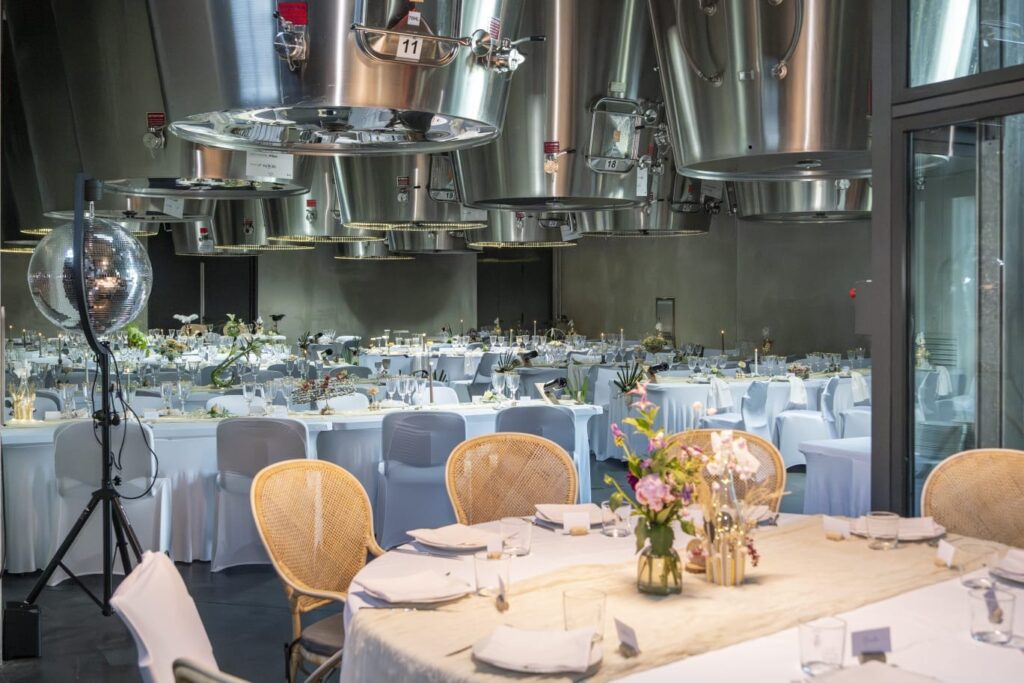
This is also the moment to check what will decide the comfort of the day: are any suppliers imposed, how late can there be music, is parking provided, is the venue accessible to guests with reduced mobility. Here, no supplier is imposed, dancing is possible until four in the morning in the vat room, and the private car park takes coaches.
Eleven to nine months: caterer and beds
The two resources that run out next. Good regional caterers book almost as early as venues, and for the same dates.
Beds deserve particular attention, because they are always overlooked. A room may seat a hundred and thirty; the number of beds on site is fixed. The estate says it can sleep up to 29 people across its three houses — ample for the couple, close family and guests travelling far, but not for everyone. The rest is booked nearby, and now is the time.
See the estate’s accommodation to settle who stays on site.
Eight to six months: the shape of the day
This is where the venue stops being a room and becomes a running order. Where the ceremony happens, where drinks are served, where dinner is, where the dancing is.
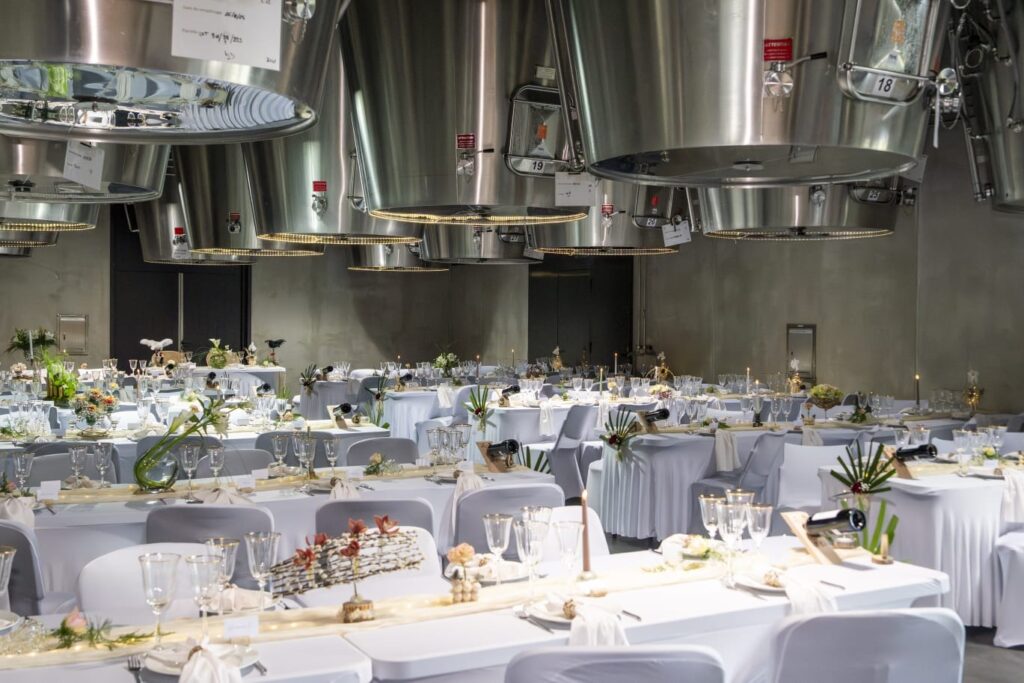
A wine estate rarely offers a single space, and that is the point. The Emile Peynaud vat room, around 230 m² (2,475 sq ft), seats in the order of 130 people and takes up to 180 for a cocktail reception when the outdoor spaces are used. The barrel cellar, around 130 m², holds about a hundred. There is also the garden, well suited to a secular ceremony, and the panoramic terrace for drinks.
The exercise is to spread the moments across those spaces without making guests walk awkwardly — and without making the whole day depend on the weather.
Five to three months: what people will see
Decoration, seating plan, stationery, music, photographer if not already settled. Everything that does not exist only once and competes with nobody.
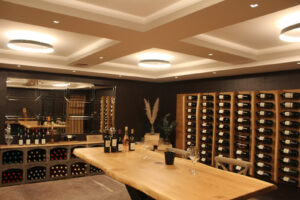
It is also the moment to arrange the menu tasting with the caterer, and to choose the wines. A wine allowance from the estate — in the order of one bottle per three guests — is built into the reception packages, so it belongs in the budget now. At a wine estate that last point deserves more than a tick-box: tasting the cuvées alongside the planned menu often changes the choices. The private table at Les Chais de la Fleur lends itself well to that trial.
Two months to the eve: logistics
Confirmations, the final seating plan, precise timings given to every supplier, directions sent to guests.
One point often neglected: getting home. A wine estate is in the countryside, the evening can run until four in the morning, and guests will have been drinking. Shuttles, group-booked accommodation, taxis warned in advance — that is what separates a calm end of night from an awkward one.
What should you ask when visiting a venue?
The questions with a number for an answer, because those are the only binding ones.
Exactly how many seated covers, and in which layout? How late is music allowed, and at what volume after a given hour? How many parking spaces, and can a coach turn? What is the fallback if the outdoor ceremony becomes impossible, and how late can you switch? Who clears up, and by when must the site be vacated the next day?
A visit spent talking only about atmosphere leaves all of that open — and those are the answers that, six months later, decide how comfortable the day is.
What this calendar does not say
That it is indicative. A wedding for forty on a Friday in March can be organised in four months without difficulty. A wedding for a hundred and forty on a Saturday in June may need eighteen to secure the date you want.
The useful rule is not a number of months: it is knowing, at each stage, whether what you are after exists once or a hundred times.
In short
Twelve months for the venue and the date, nine for the caterer and the beds, six for the shape of the day, three for what people see, two for logistics. And at each stage, the same question: does this exist only once?
Arrive with several dates, settle the question of beds early, and leave the decoration until last. It is the opposite of the natural order, and it is what works.
And allow one buffer month somewhere in the middle. Something always slips — a supplier who cannot make the date, a guest list that grows by twenty, a ceremony that moves indoors. A countdown with no slack in it turns every small change into a crisis.
Your questions answered
How many guests can the estate host for a wedding?
The Emile Peynaud vat room seats in the order of 130 and takes up to 180 for a cocktail reception when the outdoor spaces are used; the barrel cellar around 100. Exact capacities are confirmed with the estate according to the layout chosen.
How many guests can sleep on site?
The estate says it can sleep up to 29 people across its three houses. Remaining guests stay in accommodation nearby.
Is a caterer imposed?
No. Caterer, DJ and photographer are free choices, which keeps both budget and style in your hands. A wine allowance from the estate is still included.
How late can the evening run?
Dancing is possible until four in the morning in the vat room. The cut-off varies by space.
Can a secular ceremony be held on site?
The garden lends itself to one. The running order is agreed with the team when booking.
How far ahead should you book?
The estate frequently sees one to two years for weddings. For a Saturday in the warmer months, allow plenty of time. For a weekday out of season the constraint is far lighter. The deciding factor is the date, not the venue.