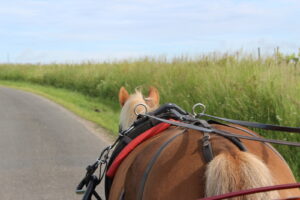
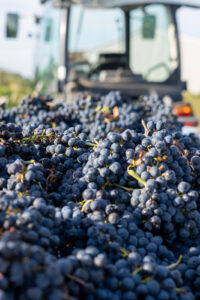
Start with a short, easy walk
With children, the best format is often the simplest one: a short walk on easy paths with a few well-chosen visual stops.
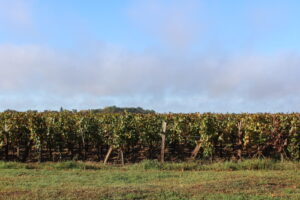
Around Saint-Émilion, village edges, quiet roads and some open paths allow you to look at the vines without requiring strong endurance.
For younger children, what matters is being able to move at their own pace, stop, look, ask questions or notice a wall, a tower or a row of vines. This kind of walk works as a natural opening to the day and prepares everyone for a more structured visit later.
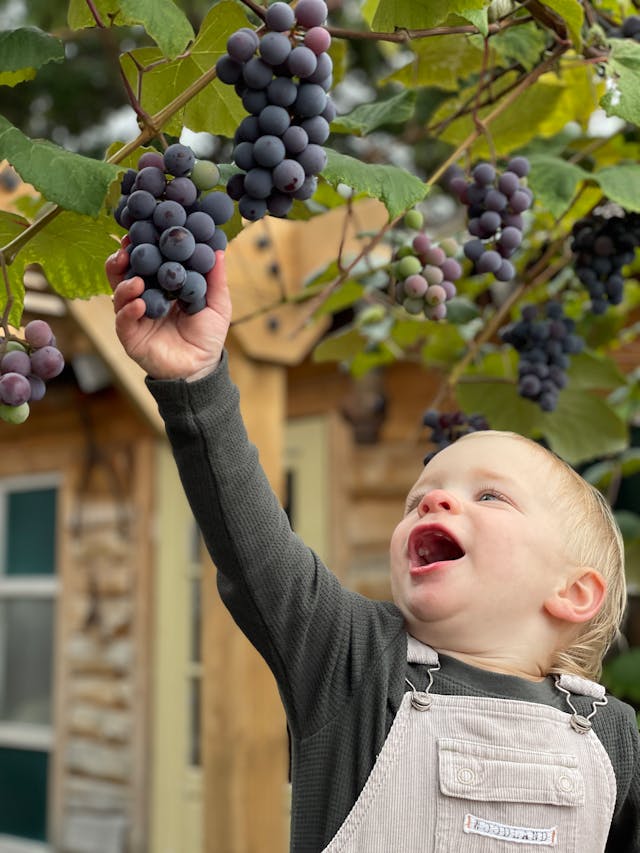
Turn the landscape into a field of discovery
The vineyard is full of concrete details that children can notice without needing complex explanations.
Rows, slopes, changing colours, stone walls, distant tractors, the contrast between parcels: all these elements can become natural markers in the walk. It is often more effective to ask a few simple questions than to give a long speech.
This approach suits family wine tourism very well because it leaves room for curiosity and avoids the fatigue of over-explaining.
- Prefer open viewpoints that are easy to read and away from dense traffic.
- Build the day with several short stops rather than one long walk.
- Let children observe at their own pace instead of turning every stop into a lesson.
- Keep small regular pauses for water, snacks or simply looking at the scenery.
Choose a visit time that matches family rhythm
When visiting a wine estate with children, timing matters almost as much as content. Late morning or mid-afternoon often works well, because it avoids both the fatigue of a very early start and the low-energy moment after a long lunch.
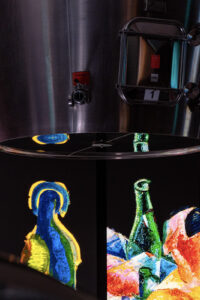
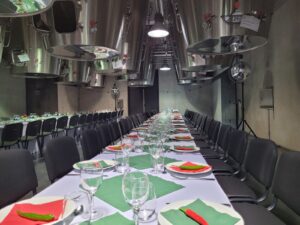
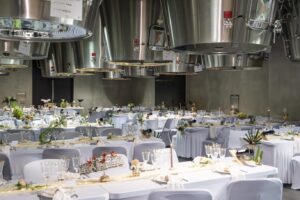
A place like Château La Fleur de Boüard is well suited to this because it allows a balance between discovery, observation and a visually engaging environment. The Cellar of Light, for example, can capture attention through architecture and staging, making the experience more lively than a purely technical tour.
For adults, it remains a genuine introduction to the world of wine; for children, it becomes a discovery of space, light and atmosphere.
Keep the tasting as an adult moment without excluding children
A family visit does not mean that everyone must experience exactly the same thing at the same time. Tasting is primarily designed for adults, but it can fit naturally into the day if children have already walked, observed and had time to settle.
It then becomes easier for them to remain calm for a short while, especially if the tasting is not stretched unnecessarily.
The key is not to force children to be interested in wine itself, but to let them remain part of a calm and pleasant setting. This makes the whole day better for everyone.
Add a quiet snack break or relaxed pause
In a family wine tourism day, the ‘in-between’ moments often decide whether the outing feels enjoyable or exhausting.
A snack break, a simple lunch, or just sitting together on a terrace or in a shaded area can make all the difference. Children recover, adults keep talking, and the day breathes.
There is no need to multiply locations. On the contrary, fewer changes usually mean more comfort. If you build a route around Saint-Émilion and Néac, two or three carefully chosen steps are usually more successful than a forced sequence of visits.
Practical cues for a successful day
Bring water, snacks and comfortable shoes for everyone.
Choose a simple itinerary with limited parking and car changes.
Check the estate’s visiting conditions in advance, especially with young children.
Prefer a shorter, well-paced day to an over-ambitious programme.
Remember that the success of a family outing depends more on atmosphere than on the number of activities.
In the end, family wine tourism works when it respects the very nature of travelling with children: you observe more, slow down more often and accept a little improvisation. That rhythm is not a limitation; it can actually make the discovery deeper. By taking time to look at the landscape, moving gently through the Saint-Émilion and Néac area, and finishing with a well-chosen estate visit, you shape a day that feels coherent, simple and memorable.
We answer your questions
Can you do wine tourism with children without making the day too long?
Yes, provided the programme stays light, with few steps, a short walk and a well-timed estate visit.
Do you need activities specifically designed for children?
Not necessarily. Very often, landscape, walking and a visually engaging setting are enough if the rhythm is adapted.
Can an estate visit suit a family?
Yes, especially if it is part of a balanced day. The important point is not to make the most adult part of the experience unnecessarily long.
Which season is best?
Spring and autumn are often especially pleasant for family outings, but every season can work depending on weather and the pace you want.