Start with appearance: learning to look before speaking
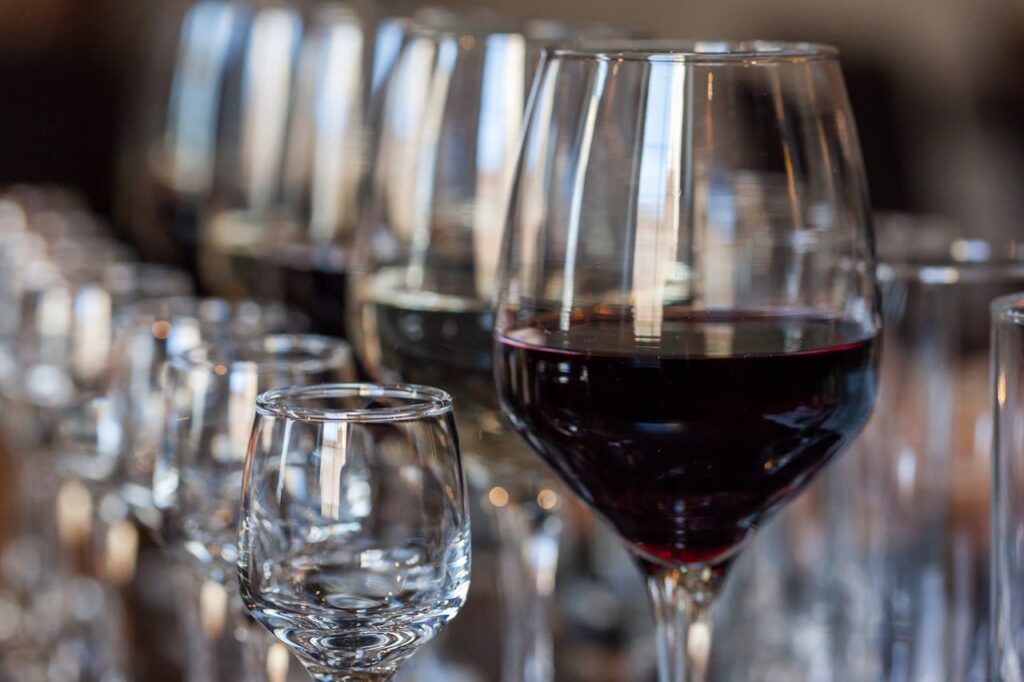
The first step in a guided tasting is to slow down. Before smelling or tasting, you observe. Appearance already provides useful cues: colour intensity, clarity, brightness, rim variation. Without jumping to conclusions, this visual reading places the taster in a mindset of attention.
Guided tastings also correct common mistakes: commenting too quickly, confusing intensity with quality, or searching for absolute answers where careful observation should come first.
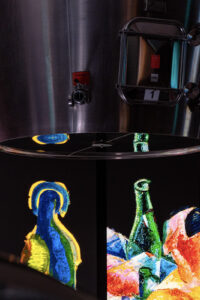
In a setting such as Château La Fleur de Boüard, this first step is especially meaningful because it extends the visit itself. After seeing the lines of the cellar, the materials, the vats and the barrels, you suddenly encounter another ‘material’ to read: the wine in the glass. This makes tasting feel less abstract and more embodied.
The nose: giving simple words to complex sensations
The aromatic phase often feels the most intimidating because it seems to require an immense memory bank. In reality, progress does not come from recognising dozens of rare descriptors, but from organising perception into a few readable families: fruit, flowers, spice, oak, development.
A guided tasting helps structure that moment: first nose, gentle aeration, second nose with more precision. The guide’s commentary is reassuring because it shows that not everyone needs to find the exact same word; what matters is recognising coherent aromatic directions.
- First nose: capture the overall impression without forcing a list of descriptors.
- After aeration: notice how the wine opens and changes.
- Helpful families: red/black fruit, flowers, spice, toasted or woody notes, tertiary hints.
The palate: understanding attack, structure and finish
The palate is not just about deciding whether you like the wine. A guided tasting teaches you to break the experience into three simple moments: attack, mid-palate and finish.
Attack tells you how the wine enters; mid-palate reveals the relationship between texture, freshness, tannin and length; finish shows what remains after swallowing or spitting. In one hour, you do not exhaust the subject, but you understand that palate analysis is a movement rather than a fixed verdict.
This is especially useful for Right-Bank wines, where apparent roundness and freshness often coexist in subtle ways.
The guide helps identify what may come from structure, élevage, vintage or estate style, without oversimplifying the wine.
Progressing quickly through a reproducible method
What allows you to improve in sixty minutes is not the quantity of information but the clarity of method. A good guided tasting gives you a reading order you can later reuse at home, in a restaurant or during another visit.
You look, you smell, you taste, then you formulate a more precise overall impression. This framework prevents beginners from getting lost in technical discourse and helps everyone build a personal sensory memory.
Why the estate context changes everything
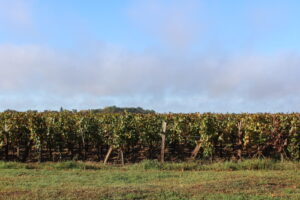
Learning to taste on a wine estate is never anecdotal. The setting reinforces understanding. When tasting is linked to landscape, an immersive cellar visit or a terroir explanation, the wine stops being abstract. It becomes the expression of a place, a material and a craft.
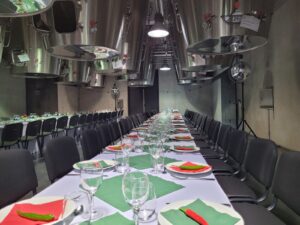
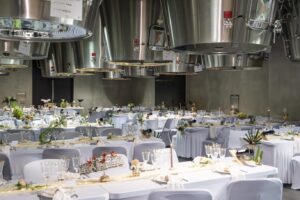
At Château La Fleur de Boüard, the visit to the Cellar of Light, the architecture, the estate and the tasting all form a very natural progression. The experience is not only educational; it is also sensorial, which makes it easier to remember.
Simple markers to keep improving after the visit
Keep the same order every time: appearance, nose, palate, overall impression.
Avoid overcomplicated words; aromatic families are enough at first.
Taste in good conditions: clean glass, suitable temperature, calm environment.
Comparing two wines or two vintages often teaches more than tasting one bottle alone.
Write notes immediately to build a more reliable memory.
The best way to improve remains repetition, but repetition guided by a few simple principles. A successful guided tasting does not overload the mind with theory; it makes you want to taste again with more confidence. That is why a one-hour format can be so effective: it is long enough to structure attention, and short enough to remain clear, lively and enjoyable.
We answer your questions
Can you really improve in only 60 minutes?
Yes, if the tasting is structured. In one hour, you can acquire a clear method and simple cues that permanently change how you taste.
Do I need prior wine knowledge?
No. Guided tastings are designed to welcome complete beginners as well as enthusiasts who want to sharpen their method.
Do I need to find the exact same aromas as everyone else?
Not at all. What matters is recognising coherent families and expressing your sensations clearly, not reciting a perfect list.
Can the tasting be combined with a visit?
Yes, and that is often the best option. Visiting the estate or cellar helps connect the wine to the place and makes learning more concrete.